- Email: [email protected]
- Phone: (+86)13363300602

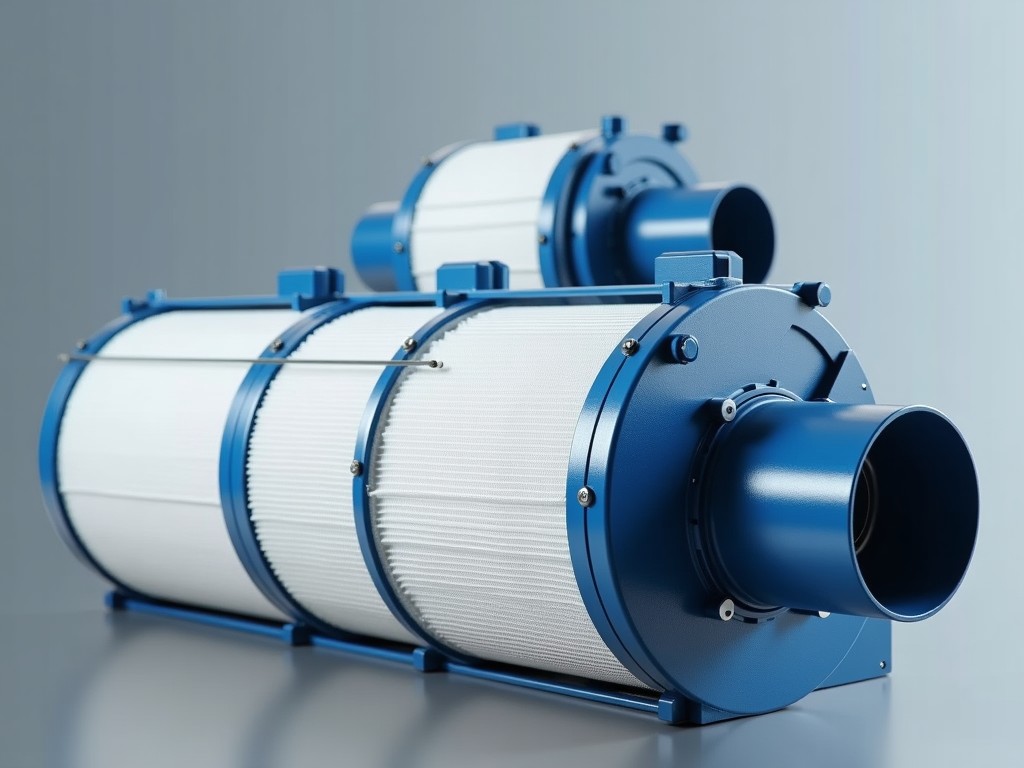
Pulse‑jet dust collectors rely on replaceable filter cartridges that capture particulate matter while allowing periodic cleaning with bursts of compressed air. The cartridges must match the collector
Request a QuotePulse‑jet dust collectors rely on replaceable filter cartridges that capture particulate matter while allowing periodic cleaning with bursts of compressed air. The cartridges must match the collector housing geometry, withstand the operating temperature and pressure drop, and provide the required filtration efficiency for the specific dust characteristics. This page explains the engineering considerations behind designing and manufacturing custom cartridges for pulse‑jet systems.
In a pulse‑jet system, dirty gas flows radially through pleated filter media. When the pressure drop across the cartridge reaches a preset threshold, a solenoid valve releases a short burst of high‑pressure air into a venturi nozzle at the cartridge’s top. The blast travels down the pleats, dislodging collected dust into the hopper below. The pleated geometry increases effective filtration area, while the end caps provide structural support and seal the media against the housing.
| Material | Max Operating Temperature (°C) | Typical Filtration Efficiency @ 0.5 µm (%) | Pressure Drop (Pa) at 0.5 m/s |
|---|---|---|---|
| Polyester | 120 | 99.5 | 120 |
| Polypropylene | 90 | 99.0 | 110 |
| Aramid (Nomex) | 200 | 99.8 | 130 |
| PTFE‑coated fiberglass | 260 | 99.9 | 150 |
Cement plants generate hot, abrasive kiln dust that demands cartridges resistant to temperatures above 200 °C and capable of handling high particulate loads without rapid blinding. In metal smelting operations, the presence of metallic fumes and fine oxide particles requires media with high tensile strength and thermal stability, such as aramid or PTFE‑coated fiberglass. Power‑generation boilers produce fine ash with varying moisture content; here, a polyester‑based cartridge with anti‑static treatment prevents premature clogging and maintains consistent pressure drop. Pharmaceutical powder handling calls for media that meets strict hygiene standards, often using polypropylene with FDA‑compliant seals. Across these sectors, the pulse‑jet cleaning method allows continuous operation because the filter surface is regenerated without shutting down the collector, reducing downtime and maintaining steady emissions performance.
Each cartridge undergoes dimensional verification using a coordinate‑measuring machine to confirm length, diameter, and pleat uniformity within ±0.5 mm. Media integrity is assessed by bubble‑point testing to ensure pore size distribution meets the target filtration efficiency. Tensile strength of the pleated pack is measured to verify resistance to handling and pressure‑pulse forces. Burst‑pressure testing subjects the cartridge to pressures exceeding the expected operating range to validate structural safety. Finally, a visual inspection checks for defects such as pleat distortion, end‑cap misalignment, or surface contamination before packaging.
| Parameter | Standard Range | Customizable Options |
|---|---|---|
| Cartridge diameter | 140 mm – 210 mm | Any diameter from 100 mm to 250 mm in 5 mm increments |
| Length | 400 mm – 1200 mm | 200 mm to 2000 mm (step 10 mm) |
| Pleat height | 15 mm – 20 mm | 10 mm to 25 mm (step 1 mm) |
| Media type | Polyester | Polypropylene, aramid, PTFE‑coated fiberglass, specialty blends |
| End‑cap style | Closed with gasket groove | Open, closed with venturi, custom flange, or integrated quick‑release |
Copyright © 2026 www.chinacartridgefilter.com All Rights Reserved.